

Reading Time: 8 Min.
Date Published: January 29, 2026 3:48 pm
Author: Matchmaking Team
Article Contents
Breakups are rarely clean. Even when relationships end quietly, traces tend to linger in the form of old messages, shared apartments, mutual friends, and the occasional late-night social media scroll. Moving on looks different for everyone, but patterns begin to emerge when you look at how people across the country navigate life after a relationship ends.
To better understand what happens after the breakup, we surveyed more than 2,300 U.S. adults about their experiences with exes. From how long it takes to move on to how many admit to checking up on an ex online, the data reveals meaningful differences in post-relationship behavior from state to state.
Read on for a state-by-state analysis of post-breakup behavior, highlighting where Americans report the most exes, the longest heartbreak recovery times, and the strongest ties to relationships past.
Key Findings
- The average American reports around 4 exes, including 2 exes from relationships lasting longer than a year.
- 47% say they’ve gotten back together with an ex.
- Definitions vary: 20% say one week is enough to count someone as an ex, while 21% say it takes 6+ months of dating.
- Moving on is often quick, but not always: 46% move on in under 3 months, while 29% need 6+ months.
- 66% still talk to a few of their exes.
- 43% admit to stalking an ex on social media.
- Two-thirds say they’d feel uncomfortable if their partner was still close with an ex.
How Many Exes Does the Average American Have? By State
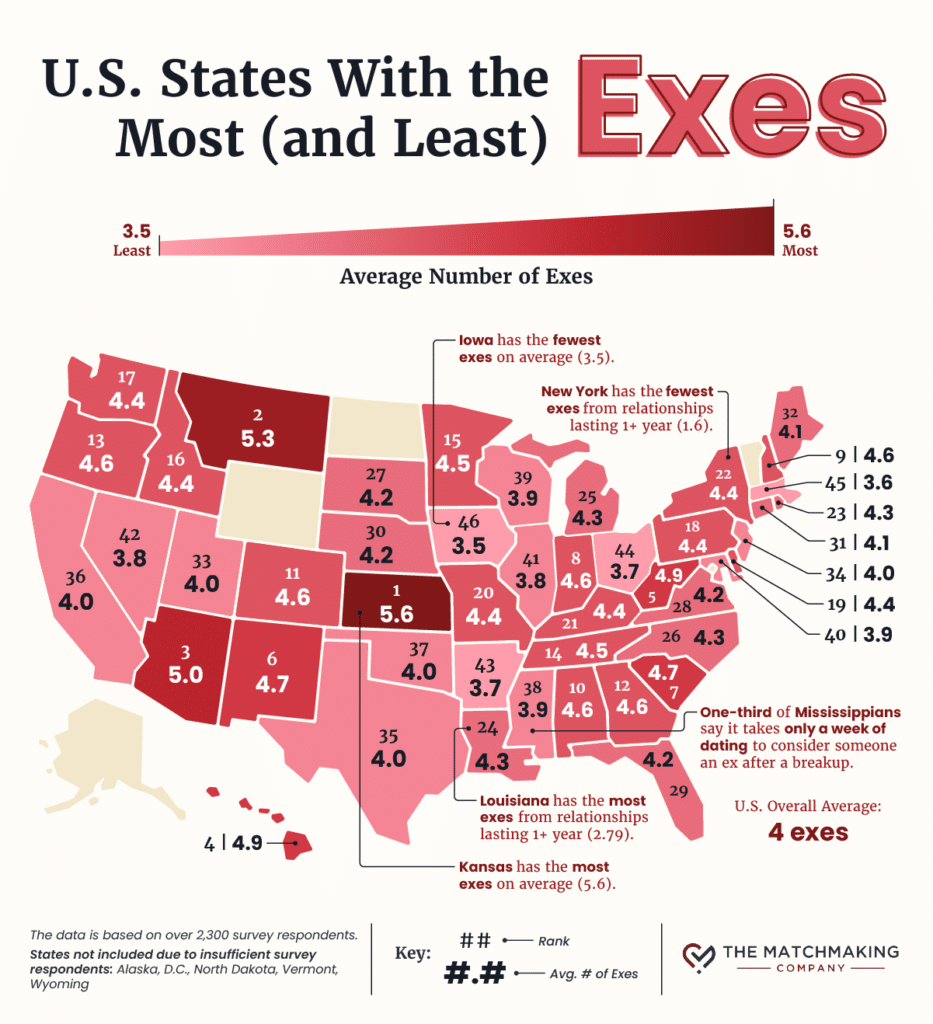
States with the most exes (highest average number reported):
- Kansas — 5.61 exes
- Montana — 5.30
- Arizona — 5.04
- Hawaii — 4.90
- West Virginia — 4.87
States with the fewest exes (lowest average number reported):
- Iowa — 3.53
- Massachusetts — 3.55
- Ohio — 3.69
- Arkansas — 3.69
- Nevada — 3.76
What makes an ex, an ex?
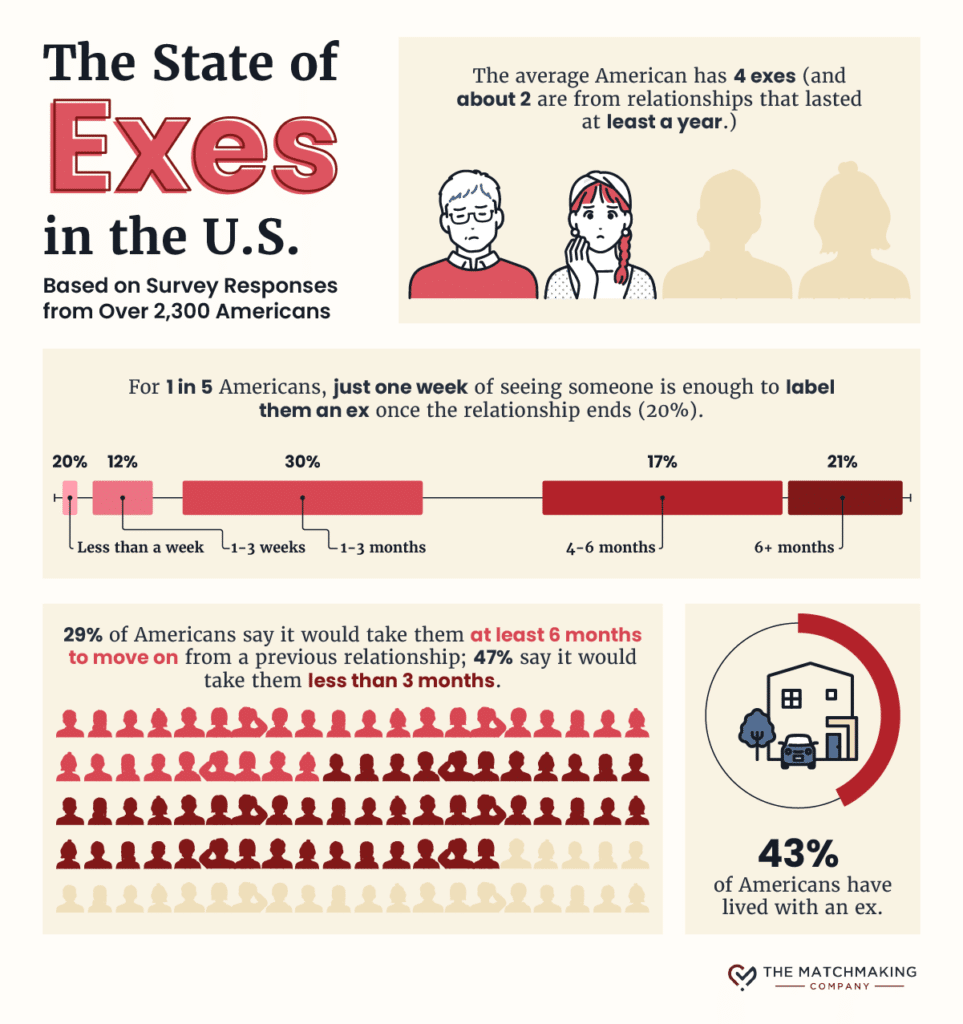
Survey responses show that the average American reports having around four exes, and notably, about two come from relationships that lasted at least a year. But people don’t agree on when someone “counts” as an ex.
For one in five Americans (20%), a relationship lasting just one week is enough for someone to be considered an ex once it ends. On the other end of the spectrum, 21% say it takes dating someone for at least six months before they’d consider them an ex after a breakup.
That timeline shifts dramatically across generations. Nearly half of Baby Boomers (48%) say it would take more than six months of dating for them to refer to someone as an ex, compared to only 11% of Gen Z who say the same. In fact, Gen Z is the quickest to apply the label: 38% say it would take just three weeks or less of seeing someone before they’d refer to them as an ex after breaking up — higher than any other generation.
Despite those differences, one thing is clear: most Americans are dating with long-term goals in mind. Nine in ten say they prefer a long-term relationship over a short-term fling (92% vs. 8%). Gen Z is the most committed to long-term dating, with 94% saying they prefer a serious relationship.
Meanwhile, men are twice as likely as women to say they prefer a short-term fling (13% vs. 5%), and Gen X adults are the most likely of any generation to report preferring a short-term fling (11%).
How Long Does It Take to Move On?
When it comes to heartbreak recovery, timelines vary widely. Nearly half of Americans (46%) say it would take them less than three months to move on from a previous relationship, while 29% say they’d need at least six months.
Men are more likely to report moving on quickly: 53% say it would take less than three months, compared to 42% of women. Women are also more likely to say it would take them more than six months (32% vs. 25% of men).
By generation, Baby Boomers are the most likely to say they move on from an ex in less than a month (17%), suggesting that distance and perspective may come a bit easier with time.
Can Exes Really Be “Just Friends”?
Few post-breakup questions spark more debate than whether exes can truly remain friends. Close to six in ten Americans believe you can truly be ‘just friends’ with an ex (58%), but opinions split by generation and location.
More than half of Gen Z adults (55%) say you can never be just friends with an ex. Baby Boomers feel the opposite: 66% say you can be friends with an ex, the highest share of any generation. Survey results show wide variation across states in beliefs about post-breakup friendships.
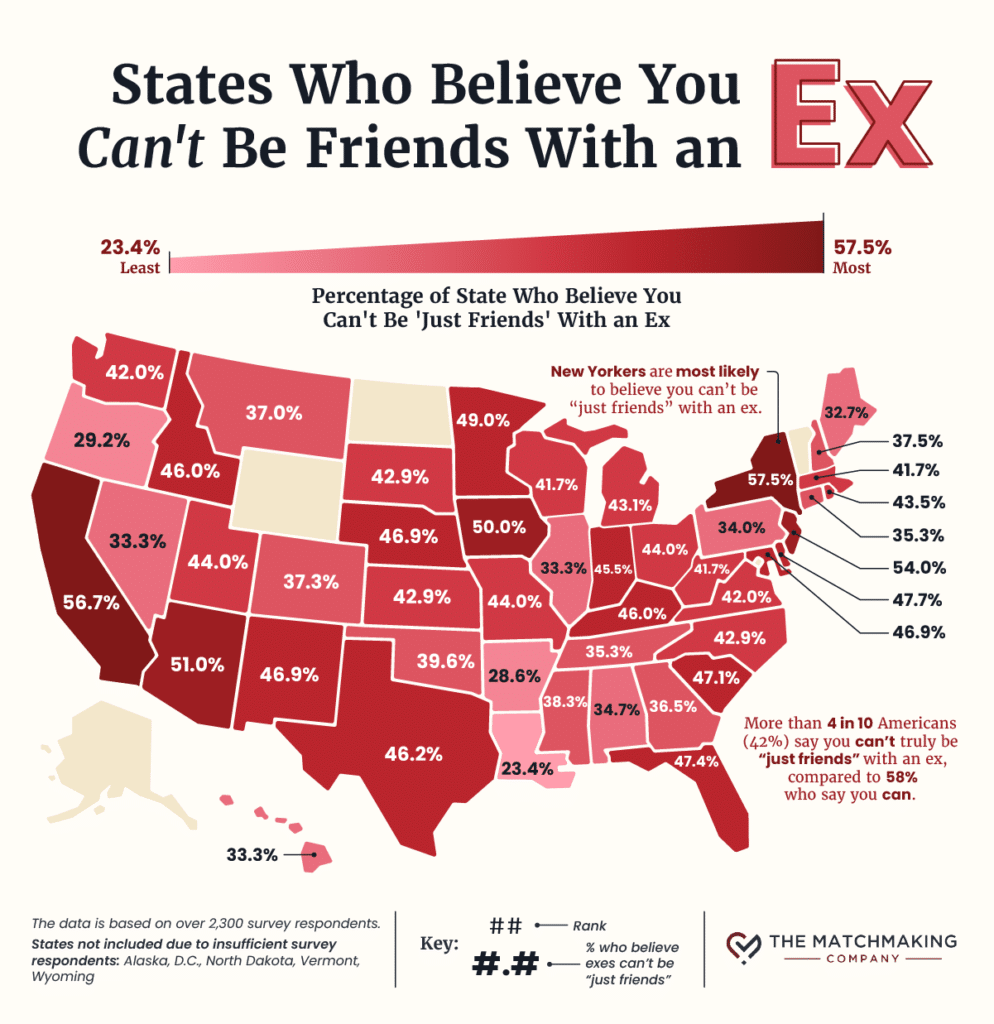
New York reports the highest share of respondents who say you cannot be friends with an ex, at 57.5%, followed closely by California (56.7%) and New Jersey (54.0%).
On the lower end of the spectrum, Louisiana (23.4%), Arkansas (28.6%), and Oregon (29.2%) report the smallest share of residents who believe friendships with an ex are not possible.
The Emotional Reality of Exes
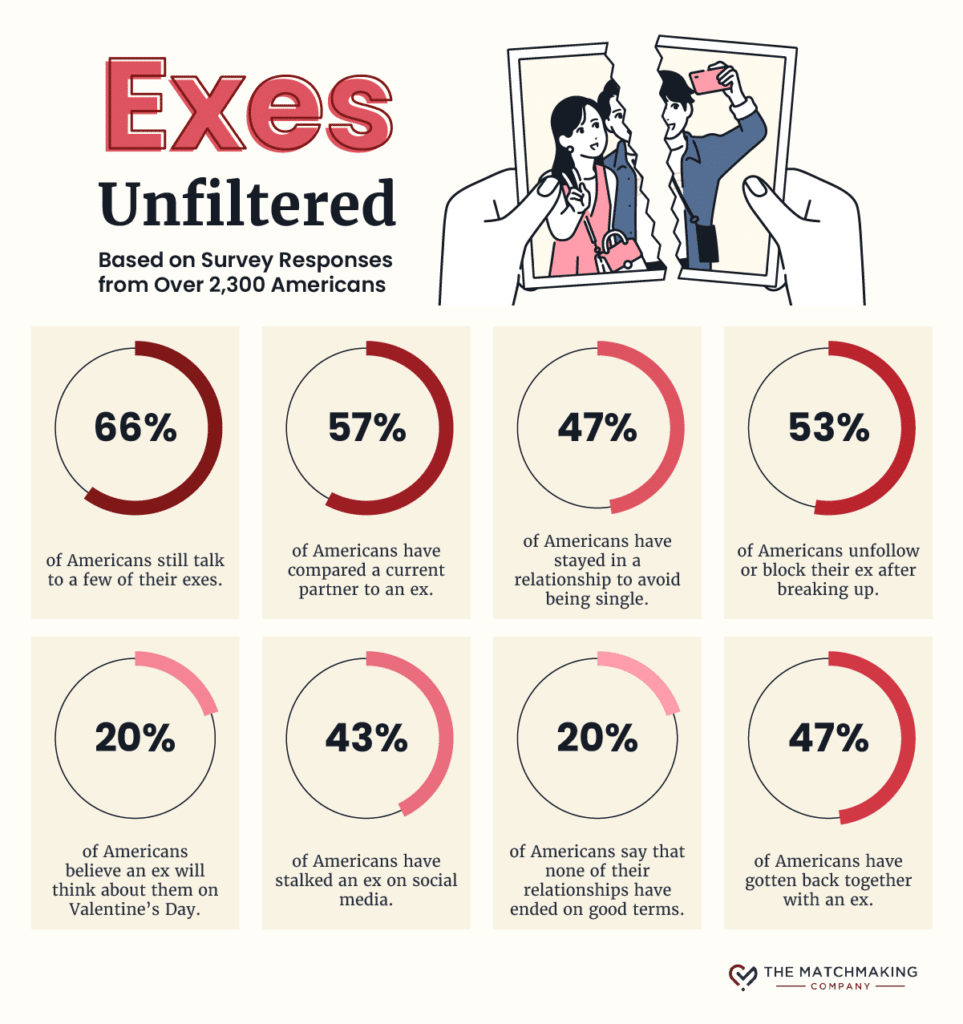
From social media check-ins to second chances, these “ex”periences are widely shared — and often more complicated than we like to admit.
For many, exes remain part of everyday life. Two thirds (66%) say they still talk to a few of their exes, and 28% of Gen Z say they talk to most or all of their exes. Connections don’t always stay platonic, either: nearly half of Americans (47%) say they’ve gotten back together with an ex after a breakup. Women are more likely than men to say they’ve reunited with an ex (50% vs. 42%), and Millennials are more likely than Gen Z to report rekindling things (50% vs. 38%).
Exes also show up in how people approach new relationships. More than half of Americans (57%) say they have compared a current partner to an ex at some point.
Online behavior plays a major role in modern breakups. While 53% of Americans say they unfollow or block an ex after a relationship ends, 43% admit they’ve stalked an ex through social media. Women are significantly more likely than men to do both: 58% of women say they unfollow or block an ex (compared to 44% of men), and 51% of women say they’ve stalked an ex on social media (compared to 31% of men). Gen Z stands out even more; they are nearly twice as likely as Gen X to monitor an ex on social media (59% vs. 33%).
That lingering attention can surface in unexpected ways. One in five Americans (20%) expect their ex(es) to think about them on Valentine’s Day.
Some ties are harder to break because they go beyond feelings and into shared lives. Forty-three percent of Americans say they have lived with an ex at some point, including 46% of women and 38% of men.
When asked who usually initiates the breakup in their relationships, women are far more likely to identify as the one who usually initiates the breakup (50% of women vs. 28% of men).
And while people may want closure, it doesn’t always happen cleanly. One in five Americans (20%) say none of their relationships have ended on good terms. On the flip side, 13% of Americans say all of their relationships have ended on good terms, and Gen Z is twice as likely as any other generation to say this (16%). Still, for many, lingering emotions remain: 50% of Americans say they have negative feelings toward their ex. At the same time, positivity isn’t off the table for everyone — Baby Boomers are the most likely to view their exes positively (59%).
Finally, relationship behavior isn’t always driven by love alone, sometimes it’s driven by fear of being alone. Nearly half of Americans (47%) say they have stayed in a relationship longer than they wanted to avoid being single. Women are more likely than men to admit this (50% vs. 41%), and Gen X adults are the most likely of any generation to say they’ve stayed to avoid being single (50%).
Even after moving on, boundaries can be a sticking point in new relationships. More than two thirds of Americans say they would feel uncomfortable if their partner was still close with an ex (67%). Gen Z reports the highest overall discomfort of all generations, with 76% feeling uncomfortable.
Closing Thoughts
Breakups, exes, and fresh starts are part of nearly every dating journey. From short-lived connections to long-term relationships, the data shows just how common it is to stay connected after a breakup, or take time before fully moving on. These experiences are shared across states and stages of life, shaping how people approach their next relationship.
We understand that moving forward looks different for everyone. Whether you’re ready to leave past relationships behind, meet new people, or approach dating with a clearer sense of what you want, our personalized matchmaking process is designed to meet you where you are. When you’re ready to start fresh, we’re here to help you make the next connection feel intentional, thoughtful, and right for this chapter.
Methodology
We surveyed 2,300+ U.S. adults over the month of December 2025 via a third-party online panel. Responses were weighted to recent Census/ACS benchmarks (age, gender, region, race/ethnicity, education) for national estimates; state insights were reported where minimum base sizes were met. States excluded from state-level reporting due to low sample sizes: Alaska, D.C., North Dakota, Vermont.
Fair Use
You are welcome to use, reference, and share non-commercial excerpts of this study with proper attribution. If you cite or cover our findings, please link back to this page so readers can view the full methodology, charts, and context.