
Reading Time: 15 Min.
Date Published: July 16, 2026 9:56 am
Author: Darci Johnson
Article Contents
Finding someone you’re attracted to isn’t always difficult. Finding someone you’re truly compatible with can feel like an entirely different challenge.
Many singles know that frustration well. They’ve experienced promising first dates that never turned into second dates, relationships that seemed exciting at first but slowly unraveled, or the disappointment of realizing that chemistry alone wasn’t enough to build a lasting partnership. After enough experiences like these, it’s natural to wonder whether compatibility is simply a matter of luck.
Professional matchmakers see it differently.
After working with thousands of singles over the years, they’ve learned that lasting relationships rarely succeed simply because two people happened to share the same hobbies or felt an instant spark. Those things certainly have their place, but they’re only part of a much bigger picture. The strongest relationships are built on something less obvious but far more meaningful: the values that shape how two people move through life together.
These are the relationship factors that are proven to predict relationship longevity. At The Matchmaking Company, these are known as Key Life Values.
Our unique, perceptive Key Life Values test is the culmination of decades of matchmaking experience combined with the findings of scientific research on what matters in long-term relationships.
Every new client completes a Key Life Values assessment at the beginning of their matchmaking journey. Our matchmakers analyze these results, along with several other lifestyle and personality factors, to determine the most compatible introductions for you.
At The Matchmaking Company, discovering your Key Life Values is a core part of the matchmaking process.
Unlike the compatibility tests you might find online, Key Life Values aren’t designed to place people into neat categories or produce a percentage score. They’re a way of understanding the priorities that influence everyday decisions, long-term goals, communication, and the way two people support one another through every season of life.
As Kathrine Wilson, Director of Matchmaking, explains:
“People confuse compatibility with chemistry. Chemistry is part of compatibility, but it’s not all of it… It’s less about the person you’re looking for having an objective ‘ideal’ set of Key Life Values, and more about their values reflecting your own.” Kathrine Wilson, Director of Matchmaking
That distinction changes everything.
Why Most People Take the Wrong Compatibility Test
Modern dating encourages us to make quick decisions.
Dating profiles ask us to judge someone from a handful of photos. First dates often become auditions where we’re trying to decide whether we felt enough excitement to justify seeing the person again. Friends ask whether there was “a spark,” as though that single feeling can predict the future of a relationship.
It’s understandable why so many people think this way. Chemistry is exciting. Attraction feels immediate. Shared interests make conversation easy.
The problem is that none of those things, on their own, tell us whether two people will build a fulfilling life together.
Heather Drury, Director of Coaching, sees this happen frequently with clients. “When people search for a spark and they don’t find it right away, they’re often left without a tangible positive about their date,” she explains. “The door closes.” Heather Drury, Director of Coaching

Director of Matchmaking Kathrine Wilson, Director of Coaching Heather Drury, and Dr. Terri Orbuch at the Global Love Conference 2026.
Yet many healthy relationships don’t begin with fireworks. They begin with comfort, friendship, curiosity, and mutual respect that deepen over time.
Take, for instance, the connection between Trinity and Bryce on season 8 of Love Island USA. This is a show where chemistry is king, and yet Trinity’s family notices something different in the way she talks about Bryce, the islander she’s coupled up with. Choosing a partner like Bryce breaks away from Trinity’s “type”. This leads her mother and sister to believe that their connection is real and lasting, because it is based on more than chemistry alone.
This doesn’t mean attraction isn’t important. It simply means attraction isn’t the entire compatibility test.
A relationship built only on excitement can lose momentum once everyday life settles in. A relationship built on shared values has something deeper to rely on when life becomes busy, stressful, joyful, or unpredictable.
That’s why professional matchmakers spend less time asking whether two people would enjoy the same first date and more time understanding whether they would enjoy building the same life.
What Are Key Life Values?
Key Life Values are the priorities that quietly shape the way you live.
They influence how you spend your weekends, what brings you fulfillment, how you approach relationships, and what kind of future feels meaningful. They’re reflected in the choices you make every day, often without realizing it.
Unlike preferences that may evolve as your life changes, Key Life Values tend to remain remarkably consistent over time, even as your interests evolve.
For example, someone may stop running marathons, but still value an active lifestyle. Someone may no longer be raising young children, yet family continues to be one of the most important parts of their identity. Hobbies and careers change. Life circumstances change, but the values underneath those experiences are often much more enduring.
This is one reason matchmakers look beyond the surface.
People often mistake hobbies for compatibility because they’re visible. Two people may both enjoy golf, cooking, or traveling, but those shared interests don’t necessarily reveal what truly motivates them. Instead, she encourages clients to focus on the values behind those activities, because that’s where lasting compatibility is often found.
The Matchmaking Company’s Key Life Values framework considers many different dimensions of compatibility, each offering insight into how two people might build a relationship together. Key Life Values include family, physical activity, sociability, and many others.
No single value is inherently “better” than another.
What matters is understanding which ones are most important to you and finding someone whose priorities naturally complement your own.
Here are a few examples:
Family and Children: Building the Life You Want Together
For many people, family sits at the very center of life.
That doesn’t simply mean deciding whether or not to have children. Family values reach much further than that.
Some people imagine a home that’s always full of relatives stopping by for dinner, grandchildren running through the backyard, and holidays spent surrounded by generations of loved ones. Others cherish family just as deeply but prefer smaller gatherings, one-on-one conversations, or maintaining close relationships with siblings, parents, or lifelong family friends.
None of these approaches is more “correct” than another. They simply reflect different ways of experiencing one of life’s most important values.
As we move through different seasons of life, family often changes shape. Young parents face different priorities than empty nesters. Adults caring for aging parents may have responsibilities that influence where they live or how they spend their time. Grandparents may discover that family becomes an even greater source of purpose and joy than they expected.
Those circumstances evolve, but the underlying value often remains remarkably consistent. This is the kind of nuance that a simple compatibility test can’t capture. It’s also why Key Life Values offer a much richer understanding of what long-term compatibility really looks like.
Physical Activity and Fitness: Looking Beyond Shared Hobbies
One of the easiest mistakes to make while dating is assuming that compatibility depends on finding someone who enjoys all the same activities you do.
It’s understandable. Shared hobbies make planning dates easier and give couples something to talk about in the early stages of getting to know one another.
But over the course of a relationship, hobbies often change.
An injury may bring an end to years of distance running. Retirement might create time for entirely new interests. Children, careers, or aging parents naturally reshape how people spend their free time. If a relationship depends solely on sharing the same activities, it can begin to feel disconnected when life inevitably changes.
Key Life Values help explain what’s happening beneath the surface.
Someone who loves cycling every weekend may not actually need a partner who owns the same bike or trains for the same races. They may simply value staying active, taking care of their health, and spending time outdoors. Likewise, someone who prefers reading on the porch or taking evening walks isn’t necessarily opposed to exercise. They may simply find fulfillment in a slower pace of life.
Neither approach is better than the other. The question is whether two people naturally enjoy living in similar ways. That’s the distinction matchmakers are trained to recognize.
Instead of asking whether two people enjoy the exact same activities, they ask whether those activities point toward a lifestyle that feels fulfilling to both people over the long term.
Sociability: Finding a Comfortable Rhythm Together
Another Key Life Value that often goes unnoticed is sociability.
Some people come alive in a room full of friends. They love hosting dinner parties, attending community events, traveling with groups, or making plans every weekend. Others feel happiest sharing a quiet evening at home with one or two people they know well.
Most people fall somewhere between those two extremes.
Again, there isn’t a right answer. However, problems tend to arise when partners have very different expectations about how they want to spend their lives together without recognizing those differences early on.
Imagine one partner who looks forward to entertaining friends every Saturday night while the other dreams of peaceful weekends spent hiking, reading, or simply enjoying one another’s company at home. Neither person is wrong, but if those expectations are never discussed, they can slowly become a source of frustration.
That doesn’t mean introverts and extroverts can’t build wonderful relationships. They absolutely can.
What matters is understanding each other’s needs and finding a rhythm that allows both people to feel fulfilled. Many happy couples balance their social lives by maintaining strong friendships outside the relationship while also creating meaningful time together.
This is another example of why compatibility is more nuanced than checking a box labeled “introvert” or “extrovert.”
It’s about understanding how each person wants to experience everyday life.
Why Shared Hobbies Don’t Always Predict Lasting Compatibility
Perhaps the clearest illustration of Key Life Values came from Heather Drury during our conversation.
She shared a simple story about recently taking up embroidery.
Her husband has no interest in embroidering himself, but every time she tells him about a new project, he leans in with genuine curiosity. He asks what she’s learning, celebrates her progress, and enjoys seeing something that brings her happiness.
“He doesn’t have to embroider anything with me,” Heather explained. “What matters is he’s listening. He’s turning toward me. He’s paying attention to what I’m saying, and he’s excited for me, not because it’s exciting to him, but because he’s excited for me.”
That interaction has very little to do with embroidery. It has everything to do with the values underneath it.
When couples share values, that kind of curiosity, support, and encouragement are natural parts of showing up for one another.
Heather believes these moments deserve far more attention than whether two people feel an overwhelming spark after one date.
“As coaches, we get really excited” when clients notice qualities like respectful communication, patience under pressure, or genuine kindness, she says. “Those should be the things that get you like, ‘My gosh, I’m in the presence of somebody really great.'” Heather Drury, Director of Coaching
Those are the moments that reveal lasting compatibility.
Surface Preferences vs. Key Life Values
Many singles create a mental checklist before they begin dating.
Some of those preferences are perfectly reasonable. Everyone has qualities they’re naturally drawn toward, and physical attraction will always play a role in romantic relationships.
The challenge comes when preferences begin outweighing the qualities that actually sustain a partnership.
Kathrine often helps clients distinguish between those two ideas.
Instead of asking whether someone checks every box, she encourages them to ask a different question: Are these qualities genuinely important to the life I want to build, or are they simply the picture I’ve always imagined?
The difference becomes much easier to see when you compare surface preferences with the values that often sit beneath them.
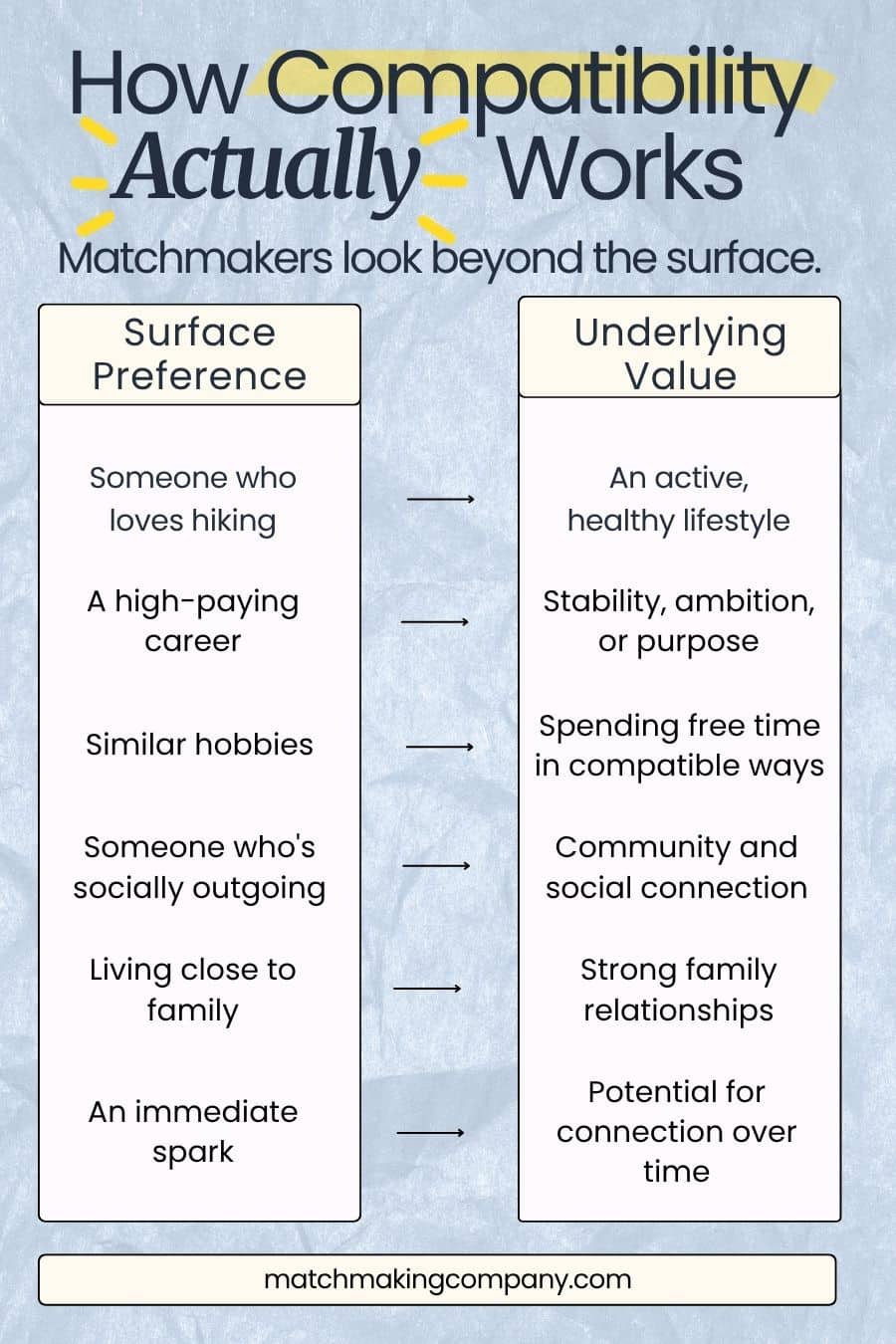
Surface preferences often tell us what catches our attention.
Key Life Values help explain what allows a relationship to thrive years later.
That’s why The Matchmaking Company’s approach begins beneath the surface. Rather than treating compatibility as a checklist of traits, matchmakers seek to understand the values that shape a person’s everyday life, because those are often far more predictive of long-term happiness than the qualities people notice first.
Why Matchmakers Look Beyond the Checklist
If you’ve ever felt discouraged after another disappointing date, it’s tempting to assume you simply haven’t met the right person yet.
Sometimes that’s true.
Other times, the challenge isn’t finding people. It’s knowing what you’re really looking for.
Kathrine says one of the biggest shifts clients experience is learning to separate the qualities that create lasting happiness from the qualities they’ve been conditioned to prioritize.
“You have to be ready and willing for it. A lot of people do think in terms of checklists, because societally, the checklist mentality is kind of what we’re conditioned to adopt.” Kathrine Wilson, Director of Matchmaking
She often encourages clients to ask themselves whether a particular preference is truly important to them or whether it’s something they’ve simply come to believe they should want.
That conversation isn’t about convincing someone to lower their standards.
It’s about helping them discover which standards matter most.
For one person, that may be finding someone who values family traditions. For another, it may be emotional openness, intellectual curiosity, or maintaining an active lifestyle. Those priorities become much clearer when they’re viewed as Key Life Values instead of a collection of isolated preferences.
That’s one of the biggest differences between human matchmaking and simply filtering profiles online.
A profile can tell you someone’s age, occupation, height, or favorite hobbies.
It can’t explain why those things matter to them.
A matchmaker can.
By taking the time to understand a client’s values, life experiences, and long-term goals, matchmakers begin seeing patterns that aren’t immediately obvious. They can recognize when two people who appear different on paper are actually likely to build a wonderful life together because the values guiding their decisions are remarkably similar.
Compatibility Grows Through Intention
Another misconception about compatibility is that you either have it or you don’t.
Heather believes healthy relationships are much more intentional than that.
“This journey of dating, in order to be done correctly, must be done with intention,” she explains. Many singles become caught up in expectations from friends, social media, or past experiences without slowing down long enough to understand their own patterns or what they’re genuinely looking for in a partner.
That’s why coaching and matchmaking often begin with conversations rather than introductions.
Before trying to identify a compatible partner, it’s important to understand the person you’re matching.
Over time, Heather says many clients experience moments of clarity they never expected.
“By session three or four, [clients] are having really profound moments of clarity that allow them to more accurately identify possible partners who are compatible and value aligned. Then dating starts becoming really fun because they’re actually genuinely looking for certain things that are true to their own authentic self.” Heather Drury, Director of Coaching
That doesn’t happen because someone hands them a better checklist.
It happens because they begin looking at compatibility through a different lens.
The Best Relationships Aren’t Built on Perfection
One of the most refreshing ideas that emerged from our conversation was that compatibility isn’t about finding someone who’s exactly like you.
In fact, some differences can become a relationship’s greatest strengths.
Heather reflected on her own professional relationship with Kathrine, explaining that although they approach situations differently, they’re united by a shared desire to help people. That common purpose allows their different perspectives to complement one another rather than create conflict.
The same can be true in romantic relationships.
Two people don’t have to enjoy the same hobbies, think exactly alike, or agree on every preference to build a happy life together.
What matters is that they share the values that help them navigate disagreements with respect, celebrate one another’s successes, support each other during difficult seasons, and continue growing together over time.
As Heather puts it:
“When your values are aligned, then the imperfections are the things that are really exciting. And when somebody can love you even though you’re not perfect, even in your dark times, that is magical.” Heather Drury, Director of Coaching
Compatibility Is Deeper Than a Test
Despite what countless online quizzes promise, no compatibility test can accurately predict the future of a relationship with a percentage score or a list of shared interests.
Real compatibility is more nuanced than that.
It develops through shared values, mutual respect, curiosity, emotional maturity, and the countless small ways two people choose to show up for one another every day.
That’s why The Matchmaking Company places such a strong emphasis on Key Life Values.
They help uncover the qualities that often matter most once the excitement of a first date gives way to the reality of building a life together. They allow matchmakers to look beyond surface-level preferences and introduce people whose priorities naturally complement one another, creating the foundation for relationships that can continue growing for years to come.
If you’ve found yourself wondering why dating hasn’t unfolded the way you hoped, it may be worth asking a different question. Instead of focusing only on who catches your attention, consider what kind of partnership you want to create and the values that will help sustain it.
Those answers often reveal far more about compatibility than chemistry ever could.